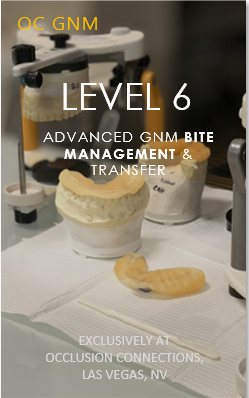
Course Description: “Bite Management, Transfer and Lab Communication”
Prerequisite Course: Level 1, 2, 3 and 4
AGD Subject Code: 610 Prosthodontics - Fixed, 010 Basic Sciences, 180 Occlusion, 250 Operative (Restorative) Dentistry
How to transition your removable and fixed orthotic to full mouth wax up and reconstruction is foundational for all advanced dentists. Dr. Chan presents and discusses in details his 2 Bite Management & Transfer System/Protocols that are required of all full mouth dentists and laboratories to master the keys to precise multi-dimensional occlusal management of any comprehensive reconstruction - . It requires an understanding of specific steps and protocols to get the results of precision and predictability.
How to communicate with the laboratory technician is key to predictable and consistent results as it relates to upper and lower arch cases. Most dentists are not familiar with what is required by the advanced laboratory technician who focuses on cosmetic arch reconstruction cases. Yet the technician puts up with flimsy bite records and lack of proper registrations to satisfy the dentist client. It is not surprising why dentists and technicians frustrated with the process and outcomes, but this is due to lack of protocols and precise systems.


Research has found that the technician often determines the maxillary cast mount for the doctor. This shouldn't be! This is not the fault of the laboratory, but should be the responsibility of the dentist to provide the proper records for accuracy and predictability of the bite and mounting of the case. Without proper maxillary cast leveling records, bite registrations and bite transfer protocols will have cants causing the dentists to continue to adjust and grind the new crowns into position. Numerous follow up adjustment visits and grinding of the bite in the finishing stage is not what dentist desire!
There are specific records, models, photographs, bite registrations and matrixes that are key to transition from a phase I stabilization stage to a phase II finishing restorative stage predictably. Break this cycle and learn proven bite transferring protocols and techniques that will increase productivity, precision and the enjoyment of dentistry.

- How to transfer and manage the bite precise with the lab technician.
- Do you know what your laboratory technician desires to receive from the dentist in order to design the ideal aesthetics and occlusion without guessing?
- Present specific techniques and protocols to manage a full mouth reconstruction from start to finish.
- Why the Modifed Fox Plane recording is important to mount the maxillary cast properly.
- OPI (Occlusal Plane Index) A key to functionally analyze the maxillary occlusal plane.
- Step by step protocols for bite mounting.
- Bite management steps from phase I to phase II.
- Bite transitioning during the wax up stages
- Optimized provisional matrixes to bring ease and precision to the bite.
- Occlusal table designing and management steps for accuracy, precision and comfort with the laboratory technician.
- Managing the Bite with Precision, Protocols and Hard Bites - Doctor Requirements
- Coordinating the Bite with your Laboratory – Laboratory Requirements
- Create the proper matrixes with the laboratory to ensure a precise and predictable result.
- Learn the perspectives directly from dental technicians who see, know and experience what actually is going on at the front lines of the laboratory.
- How to accurately and precisely transfer the vertical position of the maxillary cast
- How to accurately and precisely transfer the vertical mandibular cast
- How to accurately and precisely transfer the antero-posterior relationship.
- How to accurately transfer the new vertical GNM bite without loosing the craniomandibular relationship from orthotic stage through prep stage and onto the finishing stage.
- How to orient the maxillary casts correctly avoiding cant problems as it relates to a properly leveled head position and restorative and wax up redoes.
- Modifed Fox Plane - A simple way to accurately register the cranio-maxillary orientation to an occlusal analyzing table.
- How to properly take the Modified Fox Plane recording (as per Chan protocol) as it relates to proper balanced head position.
- How to position the maxillary cast correctly to the analyzing table.
- How to establish the maxillary occlusal plane when waxing a full arch.
- How to create the Cranial Transfer Index - To manage the maxillary cast accurately from pre-preparation through the clinical tooth preparation stages.
- How to use the bite stint to relate the mandibular to maxillary cast accurately and precisely.
- What specific photographs and poses of the patient are most helpful to the laboratory.
- How to design the occlusal plane for precise landing of the contact marks/dots.
- How to meet your bottom line net.
ABOUT YOUR INSTRUCTOR
CLAYTON A. CHAN, D.D.S. Founder/Director of OCCLUSION CONNECTIONS The Center for Gneuromuscular Dentistry & Orthopedic Advancement

Dr. Chan’s GNM teachings have afforded dentist from around the world to implement clinical occlusal techniques that have achieved outstanding results in “real world” dental practices. His leadership and pioneering role in both “gneuromuscular” (GNM) and neuromuscular (NM) occlusion has been recognized, by his peers, for his ability to deliver outstanding care to his patients as well as present the most advanced principles dentistry and the treatment of TMD patients. When taking OC’s Masterclass training, you can be assured you are taught the most up to date and clinically relevant techniques, based on sound science, substantiated protocols. Dr. Chan shows and demonstrates live proven clinical techniques that you will learn, be inspired, become skilled, successful, profitable and confident in integrating the GNM concepts into your dental practice. More About Dr. Chan
The "ADVANCED BITE MANAGEMENT &TRANSFER LEVEL 6" seminar I attended this past weekend more then met my expectations. Dr. Chan can take a complex procedure and relate it to his audience in a very direct, thorough and simple way. Very few lecturers have this gift. Bite management and how to communicate this to your laboratory technician is key to a succesful out come of any case. We learned how to obtain a modified fox plane and create a Cranial transfer Index from this. We went into depth on how to transiton the orthotic (fixed and removable) and neuromuscular postion accurately. In my opinion you can't see this enough. Because without this knowledge your laboratory technician is guessing on how to mount and set up your case. I can't wait for Dr. Chans next seminar he is truely an inspiring and edifying lecturer."
- Thomas Zafiratos, D.M.D., Chicago, IL
- Byron Blasco, DMD, Las Vegas, NV (former Nevada State Board Dental Examiner)
“This course brings bite management and predictability to a whole new level not dreamed possible using existing bite management techniques – Totally a new harmonic of success possible!”
– Keith Allen, DDS, Calgary, Alberta, Canada
“Yes, as soon as I get back to my office I will be able to apply this information in my practice.”
– Derek Okamura, DMD, Vancouver, British Columbia
"Sitting in Level 6 this last week, I counted no less than four steps in what we thought of as "bite management" where we unknowingly build error back into our cases. Clayton teaches a true Bite Management protocol that is consistent and predictable. It does require attention to detail but is certainly within the abilities of any doc that is doing complete arch dentistry....Today I delivered the second part of a full mouth following the protocol for seating crowns that I learned this weekend. Both chairside assistants commented on the ease of the delivery and that they did not feel stressed even though they were learning a new technique. I did not touch the contacts and when I preliminarily checked the occlusion, the bite was right on. I am bringing the patient back in tomorrow to TENS and dial the bite in. I was amazed at how well the delivery went.
We worked a good bit with Sapphire this weeken to the point that I am very comfortable with the material. Tomorrow, I will take my first Sapphire bite on my patient and I am totally at ease with the procedure. The same thing holds true for the Fox Plane. I took my first today since Level 6 and it went beautifully. I am looking forward to moving forward with this case....I wish I could find the words to express how exciting dentistry is again.
I would simply like to say to all of you who are on the fence trying to decide if they are going to take any of Clayton's courses, ... however the courses that Clayton has developed fill in the gaps in our training an take us beyond ...."
- Dr. Chris Mohler, Beaufort, South Carolina
"Looking back at the FMR cases I did over the years, I have always been troubled with the toothy look, meaning, when patients smiles too much posterior teeth are visible, and chipping ceramic in the posterior regions in 6-mo and 1 year recall follow-up visit. There were a fair amount of time involved in adjustment contacts at cementation visits and post op... After two days of Level 6, all of those questions were answered thoroughly and more. A detailed protocol for bite management was presented, a protocol to minimize errors and adjustment time and produce naturally looking soft smile line. I agreed ....that Level 5 and 6 are the best clinical courses that I have taken. I can't wait to learn proper microocclusion and coronoplasty techniques. Again, the manual alone is worth the tuition. It just shows the passion and time Clayton put in to produce quality manual."
- Dr. Hoa Nuygen, Ottawa Ontario CANADA
"As one of the participants in Level 6 this weekend, I believe it is we who must thank you for sharing your passion and your desire to be a positive influence on all of us, for your tireless dedication to the pursuit of excellence, and for including all us on your journey. Your message is focused and rooted in research instead of dogma. It is impossible not to assimilate the information for immediate clinical use. The presentation and course manual are first-rate. You really hit a home run with this class. What emerges is a remarkable educational experience that is enhanced and enriched by the fostering of new, and renewal of past, connections between colleagues. That will certainly rival the amazing course information as the weekend's highlight.
Thank you, Clayton, and all of the people that make your programs a reality, and for all connections you help us make!"
- Gary Lederman, D.D.S., Belmore, NY"